The People’s Jeans
Classic five-pocket jeans drafted from your waist, hip, rise, inseam, and thigh measurements. Choose a standard shaped outseam, Selvedge A straight rail, or Selvedge B knee dart beta without changing your selected fit or leg shape. The current public configuration includes a zip fly.
Build The People’s JeansEnter your measurements and customize. Preview before you buy. One payment includes lifetime regeneration.
Drafted from 5 of your measurements. No size chart approximation.
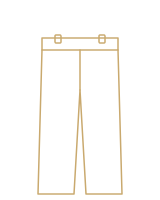
Levi Strauss and tailor Jacob Davis patented copper-riveted work trousers in 1873 for California gold miners who kept tearing out their pocket corners. The five-pocket jean has changed very little structurally in 150 years. A measurement-driven draft gives you a more relevant starting point through the rise, thigh, and inseam than a fixed size chart. Sew a test garment to check measurements, ease, and fabric behavior before cutting final denim.
Default Style
This pattern starts with settings that match the garment shown here. You can change them before generating the preview.
- Starting style
- Custom. Start from the standard draft
- Closure
- Zip fly
- Fit
- Regular
- Leg shape
- Straight
- Outseam construction
- Standard shaped outseam
What You Get
- Pattern pieces: Front Panel, Back Panel, Waistband, Underlap Shield, Slant Pocket Backing, Slant Pocket Bag, Back Patch Pocket, Belt Loop Strip
- Included downloads: Tiled PDF, instructions PDF, A0, ARCH D, ANSI D, projector PDF, and projector SVG files.
- Construction steps: 1. Prepare fabric and machine / 2. Check the pattern, cut and transfer marks / 3. Baste a fitting shell with a temporary waistband...
- Materials guide: Fabric recommendations with yardage estimates, notions list, needle and thread guide, and machine settings
- Scale check: 1:1 verification square so you can confirm print accuracy before cutting any fabric
Customizable Options
Drafted from 5 of your measurements
Every dimension is drafted from your measurements. No grading, no size charts.
| What we draft | Source |
|---|---|
| Waist circumference | Drafted directly from your waist measurement |
| Hip circumference | Drafted directly from your hip measurement |
| Crotch rise | Drafted directly from your rise measurement |
| Thigh circumference | Drafted directly from your thigh measurement |
| Inseam length | Drafted directly from your inseam measurement |
Fabric Recommendations
- Denim
- Stretch denim (2% spandex)
How This Pattern Was Developed
Automated checks cover drafting inputs, geometry, seam interfaces, print output, and grading cases. Physical sewing is tracked separately.
- Draft version
- v40
- Drafting review
- Drafting verified
- Physical sewing
- Planned
- Latest recorded update
- August 23, 2026
- Published maker proof
- None published yet
Automated drafting and output checks are recorded above. Physical samples and external tester evidence are published only after completion and consent. Sew a test garment before cutting final fabric.
How development and testing works Measurement guide Tester program status
Customer Reviews
No public reviews yet. Generate a preview, check the draft, and share fit feedback after sewing.
Frequently Asked Questions
What weight of denim should I use?
A 10-12 oz denim is the sweet spot for everyday jeans - sturdy enough for structure, light enough to sew on a home machine.
Do I need a special needle for denim?
Yes - use a denim/jeans needle (size 90/14 or 100/16) and a longer stitch length (3.0-3.5mm) for clean seams through thick layers.
Which fly closure is included?
The current public configuration includes a zip fly.
Can I use selvedge denim?
Yes. Selvedge changes the outseam construction, not your selected preset, fit, leg shape, rise, fabric behavior, or opening. Version A keeps a straight lower rail. Version B Beta adds a front inseam knee dart. Both use single layer cutting guidance and an open pressed outseam that keeps the woven edges intact.
What measurements does this pattern use?
It drafts from Waist circumference, Hip circumference, Crotch rise, Thigh circumference, and Inseam length. The pattern is generated from your body measurements instead of a fixed size chart.
Development Log
-
Selvedge is now an outseam construction choice across every public jeans starting style, fit, leg shape, rise, fabric behavior, and both supported seam allowances. It no longer changes a selected style to Slim Straight. Version A keeps the straight woven rail. Version B keeps the same selected silhouette and adds its front inseam knee dart. The runtime walks rendered front and back inseams, the complete upper side seam with zero intentional ease, the lower rails, yoke, waistband, crotch joins, folds, guides, and allowances. Unsafe explicit crotch extensions stop with a case-specific diagnostic. Version B remains a physically unvalidated beta, and both methods still require sewn denim samples.
-
A family-wide audit found that Standard jeans still treated cut coordinates as finished dimensions even though the dashed inset ring is the line that gets sewn. Standard, Selvedge A, and Selvedge B now measure waist, hip, thigh, knee, and opening from rendered stitch geometry and reject a draft beyond 1/32 inch. The automated matrix covers every standard size at both supported seam allowances, all six leg shapes, all three fits, all five rises, and every shared jeans entry point. Version B also fails closed unless its two printed dart stitch legs match and its closed geometry returns the calculated knee, opening, matched inseams, and 1/8 inch Version A hem rise. A physical denim sample is still required.
-
Selvedge Version B now verifies its actual closed geometry instead of assuming the Version A seam line proves closure. The engine records and inverts the constrained knee dart transform, closes both mouth points to one source point, and restores the Version A cut line and hem paths. A rigid whole panel pivot would rotate the selvedge rail, so Version B remains a constrained and physically unvalidated beta. A sewn Version A and Version B comparison is still required.
-
The selvedge draft now keeps the full crotch stitch curve instead of drawing a false dashed chord. Its fork to thigh inseam uses a restrained hollow blend. Heritage Bootcut keeps the outseam at the entered length and raises only the inseam endpoint by 1/8 inch. The finished fold is a monotone half smile with no centered hump. The 3/4 inch double fold follows true normal offsets, and the finished opening is measured along the fold curve in every output. Positive flare remains on both panels. Standard jeans are unchanged. A physical selvedge sample is still required.
-
The initial optional selvedge beta kept the Heritage Bootcut profile but converted other presets to slim straight. It drafted a straight hip to hem cut edge, kept the upper inseam bounded, measured the Heritage knee and opening at the finished fold, matched the inseam stitch lines, and supplied narrow fabric cutting and open seam instructions. The August 23 update removed that preset conversion. A physical selvedge sample is still required.
-
Corner notches, belt loop strip guides, and large format waistband packing were fixed.
-
Waistband stabilization guidance was added, and the slant pocket backing side seam was matched to the front panel.
-
The pointed back yoke was corrected so the actual top edge removes dart intake cleanly.
-
Pattern page content and the slant pocket guide line were refined for clearer customer pages and cleaner front panels.
-
The fly method, knee and hem behavior, and explicit leg opening control were improved.
-
Lower body seam allowance cleanup, edge allowances, and geometry checks made the draft more stable.
-
Leg shape ratios, ultra low rise depth, and smooth knee curves were calibrated.
-
The People’s Jeans geometry and construction were audited, including pocket backing depth and fly construction.
-
Yoke seam preparation, fly notches, fly instructions, and fly fold depth were fixed.
-
Back lower panel seams, yoke junctions, belt loop strips, print text, and large format layout were improved.
-
Jeans yoke geometry and proportional back pocket placement were corrected.
-
A front pleat experiment was recorded but is not part of the current public configuration.
-
The slant pocket angle was aligned across the front panel, pocket bag, and overlay.
-
Front pocket construction and slant pocket bag printing were cleaned up.
-
Front pocket specs were adjusted for coin pocket width, bag depth, scoop depth, and topstitching.
-
Pocket labels, jeans ease, waistband overlap, fly backing, and fly extension width were refined.
-
Denim needle guidance was split between construction stitching and topstitching.
-
Back dart math, front assembly notches, and back pocket placement checks were added.
-
Yoke alignment, yoke waist shaping, pocket dimensions, and default yoke depth were corrected.
-
Pocket angles, belt loop rendering, panel clipping, and pocket hem support were tightened.
-
Coin pocket construction and jeans analysis work clarified how the pocket and yoke details should sew.
-
Jeans loading, yoke drafting, scoop pockets, rear pocket outlines, and measurement fallbacks were fixed.
-
Slant pocket construction, center back rise, crotch ease, and front extension controls were improved.
-
Pocket pieces gained seam allowance outlines, construction marks, and a clearer notch convention.
-
The waistband orientation and lower body shaping were corrected so the jeans drafted more predictably.
-
The launch pattern received cleaner print layout, dark mode support, and better measurement defaults.
-
The first draft that became The People’s Jeans was added with custom waist, hip, rise, thigh, knee, and inseam measurements.